How to Go Forest Bathing in Alberta

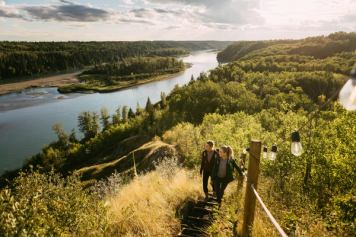
A couple explore a canyon in a forest at Whitegoat Falls in Nordegg, Alberta.

Reading time: 6 minutes

Discover the healing power of forest bathing in Alberta. Connect deeply with nature through guided experiences that emphasize tuning into your senses.

  • Go forest bathing with Nature Connected and other Alberta operators.
  • Not your average walk, forest bathing focuses on the senses.
  • Just 20 minutes spent outdoors has been shown to reduce stress.
See related articles

Slow down. Breathe in the crisp Alberta air. Listen to the rustle of aspens and the playful chirp of a black-capped chickadee. Forest bathing isn’t about hiking fast or ticking off kilometres—it’s about immersing yourself in nature and feeling its restorative power. 

In Alberta, this mindful experience comes alive where prairies meet the Rocky Mountains and sunshine filters through spruce trees. Learn about forest bathing experiences, the benefits of connecting with nature and an Indigenous perspective on spending time in Alberta’s wild outdoors.

Forest bathing invites you to use all your senses while you’re out in nature. It’s a way to connect more with your surroundings and de-stress.

What is forest bathing?

The concept of forest bathing (shinrin-yoku) was first developed in Japan in the 1980s as part of a public health initiative in support of getting people outside.

It’s an accessible practice for just about everybody. At its most essential, forest bathing means spending time mindfully in a natural setting.

While you’re outside, you’ll tune into your senses. 

What can you hear? (The breeze through leaves.)

What can you smell? (The potent fragrance of spruce tips in spring.)

What do you feel? (A snowflake melting on your cheek.)

This intentional focus can provide a deeper connection with nature than your average walk outside.

How does forest bathing work?

Forest bathing gives your brain a much-needed break, says Ken Ouendag.

Ouendag is the founder of Nature Connected. He’s a certified forest therapy guide and leads forest therapy experiences in Calgary.

“Spending time in natural environments demands less attention,” he says, “allowing for (your) cognitive resources to rest and restore. A forest bathing guide helps with this by prioritizing embodied and sensory experiences, such as listening to a breeze through the trees or the sound of moving water, which many of us don't pay much attention to ordinarily."

Within Japanese culture, knowledge of the benefits of nature go back to antiquity. People noticed that time spent outdoors helped those struggling to recover from an illness. With forest bathing, the idea is to be present, rather than focus on getting exercise, and being calm, quiet and attentive.

Spending mindful time in nature can help you feel better. As if you needed another excuse to enjoy Alberta’s great outdoors.

The benefits of spending time in nature

Research shows that just one to 10 minutes of nature exposure can boost your attention, reduce feelings of stress and improve your mood. Two hours a week out in nature has been linked to better health and well-being. And just 20 minutes at a time is shown to be ideal for reducing stress hormones, such as cortisol, in the body. 

Over the past 200 years there has been a 60 per cent decline in time spent outdoors. Alberta and other provinces have developed nature-prescribing programs (called PaRx), which allows health-care professionals to formally prescribe nature experiences to patients. But you don’t need to wait for a prescription to get outside on your own or with a guide.

At the Inglewood Bird Sanctuary, keep your ears and eyes out for birds as you take a self-guided forest bathing walk through the park.

Where to go forest bathing in Alberta

In addition to Nature Connected, there are several opportunities to take part in guided forest bathing experiences in Alberta, including:

  • Forest Fix operates out of Canmore and provides forest bathing, guided walks or hikes, and several private programs.
  • Wild Calm Forest Therapy offers nature experiences with a certified guide in various locations in Edmonton's gorgeous River Valley and the surrounding area.
  • Private forest bathing experiences with a guide are available in Banff National Park with Original Path, with the added bonus of free entry to the park in summer 2026.

“It’s always my hope that people go on a walk and then realize, ‘Oh, you know, I can actually do some of this on my own,’” Ouendag says. It’s awakening the senses, slowing down, being immersed, and noticing what may not usually be noticed.

For self-guided forest bathing experiences, you might try:

Find more Alberta hikes and nature walks that can immerse you in nature.

When you’re being mindful of the small details in the forest, you might be surprised what you come across.

What to expect from a guided forest bathing experience

For Ouendag’s Nature Connected, each forest bathing experience takes two to three hours (sometimes less in the winter). 

“People are invited to put their devices aside for the duration of a walk, and quite often they are surprised that a full three hours has passed,” Ouendag says.

Within each walk, which can sometimes be less than a kilometre, guides offer “invitations.”

“We don't use the words ‘activity’ or ‘exercise,’ because we don't want it to feel like you have to do or accomplish anything," Ouendag says. “These ‘invitations’ essentially invite participants to slow down and then to connect in some way with the space they're in.” 

Getting closer to nature with a walk in the forest

After just 15 minutes with a spruce tree, smelling its woodsy scent, touching its waxy needles and noticing easy-to-miss details (like the sticky, amber resin where the tree has been wounded), you might just feel connected to that tree.

“Within our practice, reciprocity is important in the sense that the more we get to know something—like a tree, for example—beyond just its scientific name or facts about it, the more we might care about it,” Ouendag says. “In turn, we might approach the Earth differently as well.”

Loretta Tuttauk provides wellness retreats where she shares traditional knowledge with guests from all backgrounds.

Indigenous perspectives on connecting with the land

While forest therapy offers a contemporary, guided approach to reconnecting with nature in bite-sized time chunks, Indigenous Peoples have a different relationship with the land, says Loretta Tuttauk.

A Métis Cree woman with the spirit name of Mikoh Sîsîkwan Iskwew (Red Rattle Woman), Tuttauk says, “Coming from the land, being a part of the land, encapsulates all of our ways of being. For Indigenous Peoples, time on the land is not for wellness—it is lived as a relationship...Walking, sitting, listening, offering gratitude and observing are all ways of maintaining balance and honouring responsibility to place.”

Tuttauk explains that the natural world is deeply interwoven into all Indigenous learnings and experiences. Spending time outside always involves all the physical senses, and is a mental, emotional and spiritual experience.

On a medicine walk through a forest, such as those provided by Mahikan Trails, you’ll join your knowledgeable guide to learn about the land, culture and traditional medicines.

How to learn about the land from Indigenous guides in Canada

Many Indigenous tour operators offer cultural learning experiences in nature. At Mahikan Trails, visitors are invited to engage with the land, join a medicine walk and learn practices passed down through generations. In winter, join Talking Rock Tours for a guided snowshoe trek through Elk Island National Park.

And Tuttauk’s Loretta's Wellness Circle provides wellness retreats that anyone can attend, as well as high-quality natural products rooted in Indigenous knowledge.  

The Cree concept of wahkotowin, meaning “we are all related,” reflects a deep understanding of the relationships between people, the land, plants, animals, waters and ancestors, Tuttauk says.

“The land helps us remember who we are and where we come from,” she says. “When we spend time in nature, it focuses on all parts of engagement of who we are.”